

Gallery of Human Migration Literary Award
2025 Honourable Mention
Awarded to the story
War Brides
Elisa Bryce

Total Reading Time: 7 minutes
It started with a fiddle tune accompanied by percussive coughing. The snippets of melody beckoned Winnie up the stairs of her parents’ house in Oxford, England. The sorry state of the Canadian soldier, racked with pneumonia and struggling to sleep, had kept her away. But her toes tapped to the rhythm; Winnie could not resist a catchy beat.
As a child, Winnie’s parents had sent her to piano lessons several blocks from home. On the way to her piano lessons, she passed a dance studio where girls were leaping and twirling with joy.
“Mum, can I have dance lessons?” Winnie begged when she got home.
“No! That’s not for polite girls,” her mother replied as she peeled potatoes with sturdy hands. “Go practice your piano.” Winnie stomped up the stairs to the third floor where the piano dominated the cramped office space. After her mother’s refusal, Winnie, stubborn and determined, with a mischievous twinkle in her eye, found a way to get what she wanted. Her parents gave her the tuition money for piano lessons and allowed her to walk to her lessons by herself. It was simple enough to stroll into the dance studio, sign herself up for dance lessons and use the music tuition fees as payment. As an added bonus, the dance lessons cost less than piano, so Winnie spent the excess cash on candy. She diligently continued to practice the same piano pieces at home so that her parents wouldn’t catch on. It took a few months for her mother to discover the scheme. By that time Winnie had learned to waltz.
“Go practice piano,” my mother demanded as she turned off the television.
“Just one more episode, mom…” I whined. Nearly a century later, in the 1990s, I complained about having to practice piano and violin. I wasn’t a fan of corny old fiddle music; I wanted to watch cartoons. My mother would tell me about her Grandma Winnie – my Great- Grandmother – and how she had rebelled against music lessons as a child. My mother had inherited a piano and violin from her grandparents and insisted her children learn to play music. Carrying a tune was just as important as carrying on family traditions.
But something beckoned me to keep playing, even if it was just during a commercial break. I enjoyed expressing myself through music, I just wanted to play something other than classical and fiddle music. Unlike my Great-Grandma Winnie, I wasn’t a fan of minuets or waltzes. As soon as I entered my secondary school music class, I was ready to try something different. I started playing clarinet, but the music teacher had too many clarinettists and not enough clarinets. She realized that I could read bass clef from my piano lessons and encouraged me to try out the tuba. Nobody volunteers to play tuba, but, along with a love of music, I had inherited a sense of mischief and adventure from my Great-Grandparents.
I struggled with the bulky brass instrument for the first few months. Posture, breathing, controlling which notes came out sounding nice and which ones sputtered like a wet fart – it was an enormous challenge. My pet cat ran and hid every time I dragged the massive case across the floor and started playing.
Eventually my playing improved. I was able to find a tune, catch it, and carry it along with a broad, booming bassline. The cat was able to come out of her hiding place and warily watch from a safe distance across the room. My playing caught the attention of another band member in the brass section.
“I thought you were playing the tuba as a joke, but you’re taking this seriously. Do you think you can march with that thing?” Steve asked one morning at band practice. “I’m in the Air Cadet group that meets by the airport on Thursdays. We have a marching band and really need a tuba player.”
Life is a game of truth or dare; I could not resist this new challenge. I had no objection to joining Air Cadets. Members of my family going back three generations had served in the First World War, Second World War, and conflicts in eastern Europe. All were proud to serve Canada and then return to lives of farming and music as soon as their wars ended. Nobody prays for peace louder than war veterans and soldier’s wives, and the children and grandchildren of veterans learn not to fear war – their ancestors survived, after all.
The winter of 1919 was coldly optimistic. The First World War had ended the previous November and the surviving soldiers ran, limped, and hobbled back to their homelands around the world carrying memories of death and devastation. As the soldiers processed their trauma, the Spanish Influenza ripped through battalions of idle men as they waited for permission to return home. The Canadian soldiers, living in tent encampments on the English coast, suffered so badly that local families were asked if they could shelter sick soldiers as there was not enough room in the hospitals.
This is how William, a coughing, feverish combat veteran at just twenty-four years old, came to reside in Winnie’s attic in Oxford. She brought him soup and blankets. He admired her smile and joyous sense of humour. Instead of describing the horrors he had endured in the trenches while breaking through the German lines in the last hundred days of the war, William talked to Winnie about growing up on a farm in Ontario. He entranced her with tales of herding cattle through massive snowstorms, driving tractors over rocky hills, and river rafting on hot summer days. Winnie’s curiosity and love of music kept her returning to the attic. William always had another song, another story.
“He smiles when he talks about home,” she confided in her sister. “He has a great smile. I wonder if he dances…” Winnie was twenty-two and, with the return of peacetime in Europe, she was ready to seek adventures abroad. Life in the Canadian countryside sounded ideal!
She loved hearing William play the violin, it prompted her to dust off the piano, coax him into the music room, and try some duets. Playing music together, a lovely harmony grew after the dissonance of gunfire, grenades, and explosions. William discovered European romantic melodies and learned “Humoresque” and “Traumerai”. He could read music, and his excellent sense of pitch allowed him to mimic what he heard on the record player.
As soon as he could leave his room, William joined Winnie for walks and dances. Despite his illness, Winnie noticed that he was quite strong and light on his feet. He helped out around the house too.
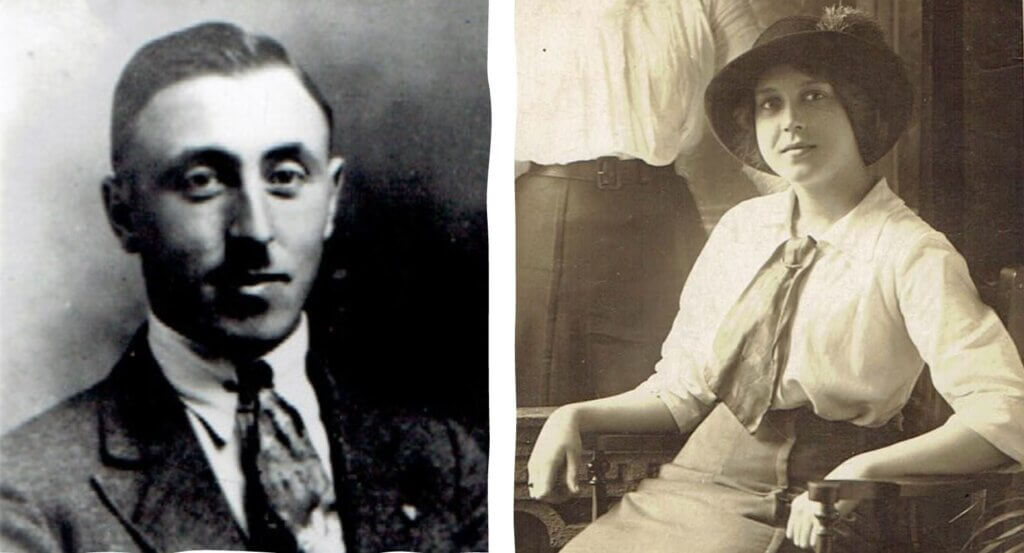
Photos of William and Winnie. Credit: The Bannerman Family private photos
“I left the farm and joined the army as I was sick of tending the potato fields,” William admitted one day as he peeled vegetables in the kitchen. He caught Winnie’s eye. “I didn’t think I could ever enjoy peeling potatoes.” She blushed and grinned.
“I may have to wound you a bit to keep you here longer – peeling potatoes,” Winnie replied with a wink. William’s improved health was bittersweet as it meant he had to return to the military camp, leaving his beloved nurse behind, so the young couple formed a plan.
William was discharged from the military in May 1919 and returned to his family’s farm in Canada. Along with his brother George, he ran a brick yard. He wrote to Winnie often and saved up the money to pay for her trip to Canada. Winnie spent her free time sewing new clothes for her future as a farmer’s wife. Her parents approved of the marriage; William had been a delightful addition to their family while he was living in the attic. Winnie’s mother rejoiced that her daughter had found someone with good sense that she actually listened to!
In late March 1921, Winnie began her emigration. She hugged her mother and sisters on the pier and hoped they would write often. Her wanderlust wasn’t dampened by tearful farewells. Winnie boarded and set sail from England on the R.M.S. Caronia, a steam ship that had been used as an armed merchant ship, then a troop carrier during the war. The ship carefully navigated the same treacherous iceberg fields that had destroyed the R.M.S. Titanic less than a decade earlier. Winnie managed bouts of seasickness as she was tossed back and forth in her bunk until she arrived safely in Halifax, Nova Scotia…and stepped off the ship to an alarming sight.
Just a few years earlier, in late 1917, the Mont Blanc, a ship carrying a cargo of munitions and explosives destined for the French war front, caught fire and exploded in Halifax harbour. Thousands of people were killed or injured in one of the largest human-made explosions in history. The shock wave was felt over two hundred kilometres away and caused a devastating tsunami in Halifax harbour. Flaming shards ignited the city’s wood buildings. Over four hundred acres were destroyed. Survivors were left homeless in the middle of winter. The size of the explosion was only eclipsed by the bombing of Hiroshima in 1945.
Winnie’s first impression of Canada was a shattered city; a place still littered with debris from tragically flattened buildings and entirely burned city blocks. She had abandoned the domestic comfort, tidy gardens and treed parks of Oxford for a post-apocalyptic wasteland. This did not match the bucolic lifestyle that William had described! Nothing had prepared Winnie for the shock of setting foot on Canadian soil.
“Surely a rail voyage will show me the postcard-worthy beauty and magnificence of Canada,” she though to herself. “William wouldn’t lie to me…” She took a deep breath and pushed doubts from her mind as she made her way to the train station.
Coming from England, full of cities, towns, and factories all bustling with life and clanking with industry, Winnie marvelled at what appeared to be a vast empty wilderness as she ate sandwiches and sipped tea. The train chugged along for hours and hours without viewing any towns or cities, just endless trees and rocks. The only signs of human activity were naked children playing alongside the train tracks in front of rough-hewn hovels. If only she could see what the Group of Seven admired in this bleak country.
It wasn’t until she reached Quebec City that Winnie breathed a sigh of relief. She felt as if she had returned to orderly civilization after escaping from a chaotic war zone. Although Winnie followed the news and had lived with a soldier, she had been completely unprepared to witness a city that had been devastated by war.
On my first night of Air Cadets, I struggled through military drill movements and awkwardly juggled my tuba. A skinny teen, barely over five feet tall, with a sagging shoulder strap, the instrument dwarfed me and drooped almost down to my knees. I took a step forward and my leg nudged the bottom of the instrument causing the mouthpiece to surge backwards and hit my face. I had effectively kicked myself in the teeth. They weren’t kidding when they said the first step on a journey is the hardest one! A kind older cadet named Jeff took me aside and gave me a few tips. He was tall with dark hair and intelligent eyes. His deep voice and confidence calmed me down. After some adjustments and realignment, I managed to waddle around playing softly, nursing a swollen lip.
Thanks to Air Cadets I got to travel to Trenton, Ottawa, Toronto, Kingston, Hamilton, and Montréal. I marched in parades, learned choreographed routines, and performed for thousands of spectators. The most poignant performances were the Remembrance Day ceremonies. The band would play for church services and march to local cenotaphs. I listened to speeches and poems recited and thought of the perils faced by Canadians not much older than myself. Every year we recommit to peace to honour our ancestors’ sacrifices.
“At the going down of the sun, and in the morning, we will remember them.” The emcee’s voice echoed, and I felt goosebumps rise on my arms. We will remember them.
“What do you want to do after graduation?” I asked Jeff, the friend who had helped me with my drill on my first night of cadets. We had built a strong friendship over the years.
“Well, I want to join the military. I’m going to apply to Royal Military College, and if I don’t get in, then I will apply to another university and try to get sponsorship through the military’s education program. If I don’t get accepted to university then I will apply for the full- time infantry…and if I don’t get in that way, then I will join the reserves.” Every option revolved around military service.
As we aged out of the cadets program we kept in touch and started dating. After graduation, I continued to study music, taught violin lessons, and worked with a community marching and concert band. Jeff got his first choice: Royal Military College. It was no surprise that he was accepted, and nobody was surprised that I was working as a musician and dating a soldier. History is a tune that gets remixed and repeated.
Jeff left for his basic officer training course a few days after graduating from high school. A long-distance relationship between a mischievous musician and a steadfast, stolid soldier was new territory for us, but I knew that it was possible. We had the technology. While William and Winnie relied on letters, Jeff and I had e-mails and telephones. We took the train to and from Kingston, Ontario to visit each other on weekends and holidays.
William and Winnie were reunited at the train station in Toronto. They spent the trip to the farm planning their wedding. After a flabbergasting journey, Winnie finally got to see the home that William had described so lovingly. Its gentle rolling hills dotted with docile cattle was a new kingdom for her to explore. The couple had a small wedding ceremony with William’s family and friends on May 18th, 1921. It was a lovely spring day followed by an evening of music and dancing.
“Wars come and go, destroying cities, leaving scars, and cruelly ending lives. But love endures beyond time and distance. Love can bravely cross continents and oceans and build a new world on a foundation of peace.”
Winnie had to change more than her last name. She had been a single, English city- dweller just a few weeks prior, now she had to become a Canadian farmer’s wife. Her days of walking to the shop or theatre were over. While William worked at the brick yard and began building a house to share with his new bride, Winnie spent her days with her new mother-in-law. Pauline was the stern, round-faced daughter of German immigrants who understood the loneliness of leaving one’s family behind and starting over somewhere new. She wanted Winnie to feel as if she belonged on the farm – a daunting feat for the city girl.
As a wedding gift, Pauline gave Winnie a cow to milk. If Winnie was going to learn how to live on a farm, she should start right away. The massive, brown beast with deadly-looking horns eyed Winnie suspiciously from a corner of the barn.
“Give her some hay,” Pauline encouraged her. Winnie picked up a handful of golden blades from the floor.
“Not that one,” Pauline corrected her gently. “The gold colour is straw. They cannot eat that. It is for bedding. You want hay, the green stuff, like grass.” Pauline directed Winnie to a pile of long tangled, greenish-yellow weeds. Winnie pulled at a handful of blades and the jumbled mass stretched between her arm and the pile a bit like cotton candy. Dust glittered golden in a shaft of sunlight.
“Smell it,” Pauline directed, “The hay should smell fresh, not musty. You must give your animals the best feed always.” Winnie wasn’t sure if this was a prank – some sort of newlywed initiation ceremony – if it was, it was a great work of mischief! Going out to the barn to sniff the fodder? Absurd! She took in the scent, warily eyeing Pauline. The hay smelled faintly sweet, like a fresh-mown lawn.
“Is it dry or wet?” Pauline asked.
“It is dry,” Winnie confirmed, squeezing the clump of hay in her palm. She pulled the handful free of the haystack.
“Good. You keep the feed dry. Give it airing.” Pauline picked up a pitchfork and tossed the hay pile like a salad. The cow watched with mild interest and added a soft “moo” of approval. “Now go feed your cow.”
Winnie, caught between a fierce woman brandishing a pitchfork and a thousand-pound animal, chose the less-terrifying option. She pulled another handful of hay from the massive pile and took her first tentative steps towards the beast. The cow stared at her and stamped impatiently with a saucer-sized hoof.
“Don’t freeze!” Pauline directed. Winnie edged closer. This corner of the barn seemed darker than the rest. She felt like a knight approaching a dragon in its lair, except instead of a sword, she had a handful of dried grass. She wished she had worn armour.
Winnie stretched her arm as far as she could, extending the peace-offering to placate the hungry beast. The cow was much larger up close. It took every ounce of courage not to turn and run away. A blast of warm, wet breath caressed Winnie’s hand as the cow sniffed the offering. Winnie’s heart pounded in her chest; she could feel sweat dripping down the back of her arm. There would be laundry to do later – if she survived.
“Let her have it!” The pitchfork-wielding German devil ordered at Winnie’s back. Who had won the war again? People had warned her about overbearing in-laws, but she hadn’t believed them. A massive tongue, larger than Winnie’s hand, extended towards the hay and gently curled around a few strands. Winnie almost dropped the hay and ran as the cow ponderously chewed. She could see her own reflection stretched in the bulging brown orbs as the cow appraised the new caregiver.
“Give her a pat. Tell her she’s good.” Pauline gently pushed Winnie closer.
“G-good cow,” Winnie slowly brushed a hand across the cow’s ear. Pauline stepped up next to Winnie and roughly scratched the stretch of fur between the cow’s eyes.
“You need this cow. It is your money and food. You must care for her, and she will care for your family. Hold your hand out flat.” Pauline hooked her arm around Winnie and guided her hand towards the cow’s mouth. The animal became more animated and chomped the hay with enthusiasm. Winnie’s hand became wet with sticky saliva. “This is a start. Tomorrow, I will show you how to milk this cow.”
As Winnie adjusted to her new milking routine, she discovered that humming and singing pleased both herself and the animal. The cow was a captive audience, and Winnie grew from cautious to confident as she filled her pails with warm, liquid, cream-coloured income for her future family. Her letters home bragged about all the money she was earning wrangling massive beasts, driving tractors, and collecting eggs from the hens. She could never have imagined herself belonging on a farm; real life was wilder than her dreams.
The summer after Jeff graduated from Royal Military College as a commissioned officer with an honours degree, we decided to take the leap and move in together. He was posted to Edmonton, over three thousand kilometres away from our childhood homes in Ontario. Jeff arrived first and found quarters on the base. I packed up my clothes and some small furniture items, but most importantly: my violin. I had a job interview for a teaching position lined up before I left home. My mother took pictures of me in front of the barn before I left farm life behind.
I had never driven so far by myself, but my ancestors had come from much further away. As I drove, I listened to music and marvelled at the uninhabited beauty of Northern Ontario. Despite yellow diamond signs every few kilometres promising deer and moose around every corner, I failed to cross paths with anything larger than a raven. I didn’t even see moose droppings at the side of the road. The biggest threat to my life was falling asleep at the wheel and dying of boredom.
Ontario’s warm hugging humidity rapidly changed to an arid coolness as I entered Edmonton. Jeff was so relieved to see me arrive that he ran out to meet my car as I pulled into the parking lot next to his quarters.
My first purchase was a sweater. Winter winds breathed through the autumn sunshine in a menacing way. My second purchase was the freshest peaches I could find at the grocery store. I desperately wanted one last taste of summer.
“It’s rock hard!” I lamented as I hacked at the peach with a knife. I sampled a flavourless slice an wanted to cry. I never thought I would miss labouring on the farm, but fresh-picked fruit and produce cannot be found in a city supermarket.
Jeff and I found an apartment off base and built our lives together with music, uniforms and laughter. We were married a year later, and my new husband received his orders to deploy to Afghanistan on a mission to train the newly formed Afghan army to guard their country against the oppressive Taliban.
I prayed for peace every day and night until he came home. I still hope that Afghanistan finds peace some day, and that ultimately, our sacrifices helped the Afghans rebuild their cities and lives.
In the new brick house that William had built on the family farm, Winnie and William started to build their own traditions. On Saturday nights, they would push the living room furniture up against the walls and invite all their friends and neighbours over to dance. William played fiddle, Winnie sang, and they waltzed and jigged in their own private dance hall late into the night. Their kitchen parties were legendary throughout the township.
William rarely spoke of the war. He preferred to leave his military service behind him. “The only good thing that came of it was meeting my Winnie,” he explained. “War is a shameful waste of young men’s lives.” He felt a great weight of guilt to live a full life after seeing so many lives cut short.
Yet, when the Second World War arrived and England was being bombed by the Nazis, Winnie, fearing for the lives of her family and friends back home in Oxford, signed the permission form for her youngest son, Leonard, to enlist in the Air Force. A few months shy of enlistment age, Leonard felt beckoned to fight to protect the lives of his relatives overseas.
Wars come and go, destroying cities, leaving scars, and cruelly ending lives. But love endures beyond time and distance. Love can bravely cross continents and oceans and build a new world on a foundation of peace. Love dares you to rise to the challenge.